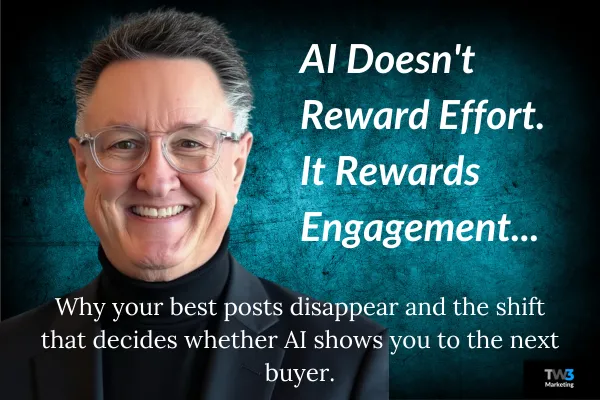
AI Doesn't Reward Effort. It Rewards Engagement.
AI Doesn't Reward Effort. It Rewards Engagement.
Why your best posts disappear and the shift that decides whether AI shows you to the next buyer.
By Bobby Christy
You're putting content out.
AI still isn't showing it.
That's the part most owners don't understand. You're writing. You're posting. You're trying to be consistent. The calendar is full. The captions are thoughtful. You're doing the work.
And still — nothing happens.
So you reach for the only lever you can name. I need to do more. More posts. More videos. More platforms. More effort. Same exhausted owner, bigger output, same flat result.
But the lever isn't more. The game changed quietly while most operators were still running last decade's playbook.
AI doesn't reward effort.
It rewards engagement.
What AI actually measures.
AI doesn't care how long you spent writing the post. It doesn't care how many drafts you went through. It doesn't care that you cleared two hours on a Sunday to think it through. It doesn't care that the photo took an hour to shoot.
It cares about exactly one thing — what other humans did with the post once it landed.
Did they stop scrolling? Did they read past the first line? Did they react? Did they comment? Did they share? Did they watch the video to the end? Did they save it?
Those behaviors are signals. Strong signals get amplified. Weak signals get buried. The platform doesn't know whether your content was good. It only knows whether other people behaved like it was.
Write this down. AI ranks reactions. Effort is invisible to it. Engagement is everything.
The honest moment most owners avoid.
Let's be honest for a second.
You've posted things that should have worked. You thought them through. You said something you actually believed. You tightened the headline. You used the right hashtags. You posted at the "right time."
And still — nothing happened.
That isn't random. That isn't bad luck. That isn't the algorithm being unfair.
That's a signal.
It means the post didn't connect. Not because it wasn't good. Not because you didn't try hard enough. It means the content didn't make someone react. The post stayed inside your head and on your screen — it never crossed into the buyer's chest.
Two people can say almost the same thing on the same day. One gets traction. The other gets ignored. The difference is rarely quality. The difference is what the audience did with it.
That's the game now. The platform isn't grading your effort. The audience is grading your relevance, in real time, with their behavior.
Why this matters more than it used to.
Ten years ago, posting more solved most visibility problems. The market was less crowded. Distribution was cheaper. The algorithm was simpler.
Now every feed has more content than any human can possibly consume. AI has stopped trying to show people all of what's available and started aggressively filtering for what each person is most likely to engage with. The competitive constraint isn't reach anymore. It's resonance.
Posts that resonate get amplified far past your follower count. Posts that don't resonate get throttled before they finish their first hour. AI does that decision in minutes, based on how the first few hundred viewers behaved. Then the post is either compounding or done.
If your content isn't generating engagement in those first minutes, the algorithm assumes it doesn't matter. The audience never sees it. Your effort doesn't get a second chance.
How proof drives engagement.
Here's where this ties back to everything we've been talking about.
Engagement isn't a personality trait. It isn't a hook trick. It isn't a hashtag strategy. Engagement is what happens when a piece of content makes someone think this applies to me.
That recognition is what makes them stop. That recognition is what makes them comment. That recognition is what makes them share it with the one other person they know who needed to read it.
And recognition almost always comes from one source — proof.
Specific results. Real examples. Named situations. Outcomes a buyer can picture themselves inside. Three leads a week to eleven in thirty days. Ten reviews to forty-eight in three months. $480K to $1.1M in fourteen months while cutting ad spend 30%.
Generic content gets scrolled past. Specific proof gets stopped on. Stopping is the engagement signal AI is hunting for. The post that delivers proof gets rewarded. The post that delivers a slogan disappears.
This is the same congruence test we run on every Authority Score. Four surfaces — Google, LinkedIn, social, website. Same question. Do they all tell the same story, with the same evidence behind it? Pass that test and AI keeps showing you. Fail it and your content goes invisible no matter how much of it you produce.
Stop posting more. Start posting things that connect.
The fix for invisibility isn't volume. The fix is relevance — content that triggers a reaction because the buyer recognizes themselves in it.
Before you write the next post, ask yourself one honest question.
Will someone actually react to this — or will they scroll past it?
If you can't picture a real buyer stopping, the post isn't going to land. Don't post it. Tighten it until it would. Add the receipt. Name the situation. Make the reader recognize themselves in the first line.
Because if people don't engage — AI won't either. The algorithm and the audience are saying the same thing in different languages. Did this matter to anyone? If the answer is no, both of them move on.
The takeaway.
The owners winning visibility right now aren't producing more. They're producing things that connect.
Connection is what generates engagement. Engagement is what AI uses as the signal of relevance. Relevance is what gets you shown. The chain runs in that order, and effort sits outside of it entirely.
You can post twice as much as you currently do and still go invisible if the content doesn't make someone react. You can post half as much as you currently do and dominate your category if every post earns a reaction.
The ratio that matters isn't posts-per-week. It's reactions-per-post.
So here's the question worth sitting with this week.
If a buyer scrolled past your last five posts, which one would have made them actually stop?
If you can't pick one, the answer isn't to post a sixth. The answer is to write the first one that would have stopped them.
— Bobby Christy, Founder, TW3 Marketing
FAQ
Q1: What does AI use to determine content visibility? AI prioritizes engagement signals — stops, reads, clicks, time spent, comments, shares, saves. Those signals tell the platform whether other humans treated the content as relevant. Strong signals trigger amplification. Weak signals trigger throttling. The decision usually happens in the first hour or two after a post lands.
Q2: Why isn't my content getting seen anymore even though I'm posting consistently? Because consistency is invisible to AI. Engagement isn't. If your posts aren't generating reactions in their first window of distribution, the algorithm assumes the content isn't relevant and stops showing it. More posts at the same engagement rate won't fix it. Better posts at higher engagement rates will.
Q3: Does effort matter in AI content ranking? No. Effort is invisible to the algorithm. AI can't see how long you spent writing, how many drafts you cut, or how thoughtfully you composed the visual. It can only see how the audience behaved when the post landed. Effort matters only to the extent that it produces content people actually react to.
Q4: How do you improve AI visibility? Create content that triggers reactions, not content that fills the calendar. Specific proof, named situations, real examples, and recognizable outcomes are what make readers stop and engage. Generic content gets scrolled past. Specific content earns the reactions AI uses as the signal of relevance.
Q5: What kind of content earns the most engagement? Content that makes the buyer think this applies to me. That recognition is the trigger for engagement. Specific results, real numbers, named situations, and proof of how a problem actually got solved consistently outperform generic advice or polished slogans. Recognition wins reactions. Reactions win visibility.
Build trust first. Growth follows. Text the word AUTHORITY to (678) 922-4561 and find out where your business really stands.
About Bobby Christy
Straight-Shooting Marketing Coach | CEO, TW3 Marketing | Author | Speaker | Host of Inside Pitch
Bobby Christy doesn’t teach marketing.
He teaches why people don’t trust you—and how to fix it.
With over 40 years in sales and marketing, Bobby has built his reputation on a simple truth:
Most marketing doesn’t fail because of traffic.
It fails because of trust.
Today, that problem is bigger than ever.
Buyers aren’t just searching Google.
They’re asking AI who to trust.
And if your business doesn’t show up with real proof, clear positioning, and consistent authority…
you don’t get chosen.
That’s where Bobby comes in.
Through his Authority Framework™, Authority Score™, and Authority Audit™, he helps service-based businesses:
Turn invisible brands into recognized authorities
Find and fix the trust leaks killing conversions
Show up where AI and search engines are already looking
Build proof that makes prospects choose them faster
His work has helped businesses move from stuck… to scaling, with measurable growth in leads, conversations, and revenue.
At TW3 Marketing, the mission is simple:
Build trust first. Growth follows.
For Podcasters, Event Planners, and Speaking Bureaus
If you want a speaker your audience will actually remember—and use—Bobby delivers.
No fluff. No theory. No recycled marketing talk.
Just real-world insight from four decades in the trenches, broken down so people can act on it immediately.
Bobby speaks on:
Why prospects don’t trust you (and how to fix it fast)
How AI is changing who gets chosen—and who gets ignored
The Authority Framework™: becoming the obvious choice in your market
Why leads aren’t the problem—and what actually is
His style is direct, conversational, and easy to follow.
It feels less like a keynote…
and more like someone finally explaining why things haven’t been working.
Audiences don’t just take notes.
They leave seeing their business differently—and knowing what to do next.
If your audience is made up of business owners, sales teams, or leaders trying to stand out in a crowded market, Bobby is the speaker who will connect.
To book Bobby Christy for your podcast, event, or stage, reach out today.