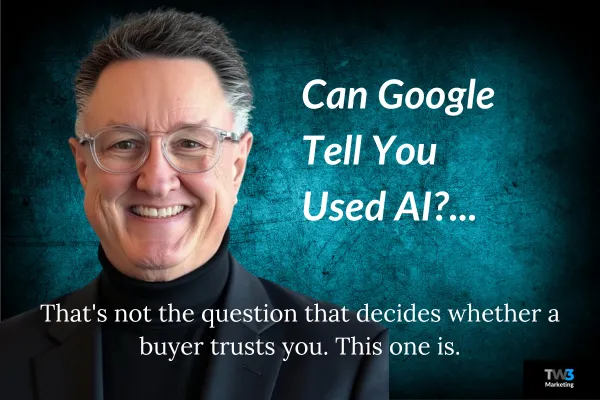
Can Google Tell You Used AI? The Better Question
That's not the question that decides whether a buyer trusts you. This one is.
By Bobby Christy
You paid to have your website updated. You started publishing on a schedule. Maybe you used AI to help write the articles, explain your services, or turn your notes into LinkedIn posts.
Then you hear that AI-generated content can carry an invisible watermark.
And the question shows up. Did we just create a problem?
I spent time recently with an NP Digital presentation on AI watermarking and the future of content marketing. Detection. Content origin. Search visibility. The growing role of human expertise. All of it worth understanding.
But the most useful thing in it was a question:
What does your content give a prospective customer that they cannot get from a generic answer?
That question deserves your attention whether you use AI every day or have never opened it.
Three different things keep getting stacked into one worry.
Watermarking, AI detection, and content quality are not the same problem.
A watermark is a signal embedded by a supported system while content is generated. What it can do depends on the technology and the type of content involved.
An AI detector tries to identify whether something was machine-generated. Its assessment is not proof of authorship. Treat it accordingly.
Content quality is about substance. Is the information accurate? Does it answer the question the reader actually has? Does it carry real experience, evidence, or judgment?
Knowing how a piece was made answers none of those.
A person can write a vague, unhelpful article with no help at all. An experienced professional can use AI to organize an explanation worth reading.
Write this down. The tool is not the trust issue. What you publish under your company's name is.
What Google's guidance actually says.
Google's published guidance recognizes that generative AI can help with research and with structuring original content. It also warns that generating many pages without adding value for users may violate its policy on scaled content abuse.
That's a far more useful starting point than trying to decide whether your writing "sounds like AI."
Look at what you are publishing and why anyone should read it.
An article that repeats the same five tips already available everywhere deserves closer examination. So does a service page that describes your company with claims any competitor could make.
"Experienced team."
"Personalized service."
"Committed to excellence."
Those phrases may be sincere. They still leave the buyer with work to do.
Experienced with what? Personalized how? What happens when a project gets complicated?
If your content doesn't answer that, who is the buyer supposed to ask?
The company-name test.
Open one of your important service pages.
Imagine replacing your company name with a competitor's name.
Would the rest of the page still work?
If it would, you just found the opportunity.
Take a contractor whose site says, "We provide honest recommendations and quality workmanship."
Now picture that same contractor explaining how he decides whether a customer needs a repair or a replacement. What gets inspected. Which findings matter. When the less expensive option is the reasonable call. What would change the recommendation?
That explanation gives the reader something to evaluate. It shows how the company thinks. It also walks a prospective customer into a better conversation.
One condition. The example has to reflect the real process. Inventing a method to make the page sound distinctive undermines the exact trust the page exists to earn.
Your experience has to become visible.
Established service businesses almost always know more than their websites suggest.
An owner knows which questions customers forget to ask. A consultant recognizes when a popular solution will create a different problem. A service professional can explain why two situations that look similar require different recommendations.
Those distinctions belong in your marketing.
Start with one question you answered recently. Write down your answer, the reasoning behind it, and an example you have permission to discuss.
Then add the exception.
That last part matters. Explaining when your advice does not apply helps a reader understand its limits. It also shows the judgment behind the recommendation. Anyone can state a rule. Knowing the edges of it is what separates a practitioner from a page of tips.
AI can help you organize that material. It can suggest a structure or surface a question you have not answered. You still have to confirm the finished piece preserves your reasoning and does not introduce a claim you cannot support.
Review three pages before you create three more.
You do not need to rebuild the whole website to begin.
Choose your homepage, one important service page, and one article a prospective customer is likely to encounter.
Ask four questions:
Does this address something a buyer actually needs to understand?
Does it show an example, evidence, or reasoning from our work?
Can we support the claims we make?
Does the reader know what to do next?
Every weak answer gives you a specific improvement to make. Perhaps the service page needs a clearer explanation of your process. Perhaps the article needs a real example. Perhaps a claim needs evidence, or more careful wording.
This is why I favor diagnosis before prescription. Creating more content is a decision worth examining, especially when the pages you already have have not yet communicated the value of the business.
It doesn't stop at the website either. A buyer checking you out looks at four surfaces: Google, LinkedIn, social, and your site. Congruence across those four is what reads as trustworthy. Volume across all four, with nothing distinct on any of them, reads as noise.
Give the buyer something worth trusting.
AI has made polished sentences easy to produce.
The harder work has not changed. Decide what deserves to be said. Support it. Make it useful to someone who is considering your services and has not decided yet.
Watermarking will continue to generate discussion. Understand the developments. Don't let the headlines dictate your content strategy.
For now, there is a practical place to start this week.
Read your website through the eyes of a buyer who does not know you yet.
If your company name disappeared from the page, would that buyer still recognize your expertise?
"AI made writing cheap. It made judgment valuable."
— Bobby Christy, Founder, TW3 Marketing
Source note: Inspired by NP Digital's September 8, 2026 presentation, "The Future of Content Marketing: How AI Watermarking Changes the Game." Google's position is summarized from its guidance on using generative AI content. The contractor example is illustrative.
FAQ
Can Google tell if my content was written with AI?
Detection and watermarking are developing areas, and no one should treat any single signal as certain proof of authorship. A watermark is embedded by a supported system during generation, and what it can do depends on the technology and the content type. An AI detector makes an assessment, not a determination. The more practical point is that Google's published guidance does not penalize AI assistance by itself. It recognizes that generative AI can help with research and with structuring original content. What it warns about is generating many pages without adding value for users, which can run into its policy on scaled content abuse. Chasing a detector score is the wrong project. Making the page useful is the right one.
Will using AI hurt my search rankings?
Not on its own. What hurts is publishing pages that give a reader nothing they could not get from a generic answer somewhere else. Volume without substance is the risk Google names, and it's the same risk a human buyer reacts to. If AI helps you organize an explanation only you could give, you're using it well. If AI is producing pages so you can say you published this week, you've created work for your reader and no reason for them to choose you.
What is the company-name test?
Open an important service page and imagine your company name replaced with a competitor's name. If the rest of the page still works, the page isn't doing its job. It describes a category, not a business. The fix is to add what only you can say: how you actually make a recommendation, what you inspect, which findings change your answer, when the less expensive option is reasonable. That gives the reader something to evaluate instead of something to skim.
How do I make my expertise visible without writing all day?
Start with one question you answered recently for a real customer. Write your answer, the reasoning behind it, and an example you have permission to discuss. Then add the exception, meaning when your advice does not apply. The exception is what shows judgment, and it's the part competitors won't copy. That's one piece of content built from work you already did. AI can help you structure it. You confirm it preserves your reasoning and does not introduce a claim you can't support.
Should I fix my existing pages or publish new content?
Diagnose before you prescribe. Choose your homepage, one important service page, and one article prospective customers are likely to encounter, and ask four questions of each: does this address something a buyer needs to understand, does it show evidence or reasoning from our work, can we support every claim, and does the reader know what to do next. Every weak answer is a specific improvement. Creating more content is a decision worth examining when the pages you already have haven't yet communicated the value of the business.
Build trust first. Growth follows. Text the word AUTHORITY to (678) 922-4561 and find out where your business really stands.
About Bobby Christy
Straight-Shooting Marketing Coach | CEO, TW3 Marketing | Author | Speaker | Host of Inside Pitch
Bobby Christy doesn’t teach marketing.
He teaches why people don’t trust you and how to fix it.
With over 40 years in sales and marketing, Bobby has built his reputation on a simple truth:
Most marketing doesn’t fail because of traffic.
It fails because of trust.
Today, that problem is bigger than ever.
Buyers aren’t just searching Google.
They’re asking AI who to trust.
And if your business doesn’t show up with real proof, clear positioning, and consistent authority…
you don’t get chosen.
That’s where Bobby comes in.
Through his Authority Framework™, Authority Score™, and Authority Audit™, he helps service-based businesses:
Turn invisible brands into recognized authorities
Find and fix the trust leaks killing conversions
Show up where AI and search engines are already looking
Build proof that makes prospects choose them faster
His work has helped businesses move from stuck… to scaling, with measurable growth in leads, conversations, and revenue.
At TW3 Marketing, the mission is simple:
Build trust first. Growth follows.
Text the word AUTHORITY to (678) 922-4561 and find out where your business really stands.
For Podcasters, Event Planners, and Speaking Bureaus
If you want a speaker your audience will actually remember and use, Bobby delivers.
No fluff. No theory. No recycled marketing talk.
Just real-world insight from four decades in the trenches, broken down so people can act on it immediately.
Bobby speaks on:
Why prospects don’t trust you (and how to fix it fast)
How AI is changing who gets chosen and who gets ignored
The Authority Framework™: becoming the obvious choice in your market
Why leads aren’t the problem and what actually is
His style is direct, conversational, and easy to follow.
It feels less like a keynote…
and more like someone finally explaining why things haven’t been working.
Audiences don’t just take notes.
They leave seeing their business differently and knowing what to do next.
If your audience is made up of business owners, sales teams, or leaders trying to stand out in a crowded market, Bobby is the speaker who will connect.
To book Bobby Christy for your podcast, event, or stage, reach out today.