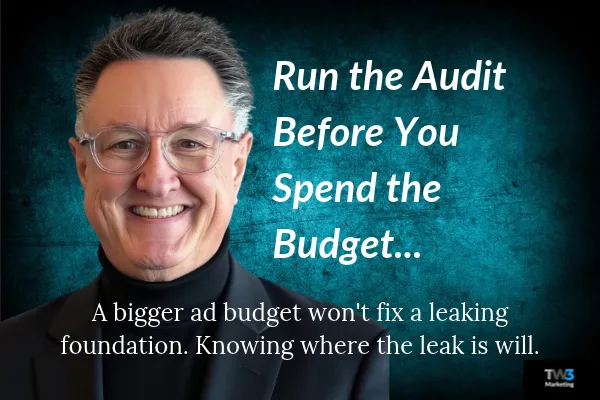
Run the Audit Before You Spend the BudgetNew Blog Post
A bigger ad budget won't fix a leaking foundation. Knowing where the leak is will.
By Bobby Christy
When marketing stops paying off, what's the first thing most owners do?
They spend more. A bigger ad budget. A new channel. Another agency with another promise.
That's the wrong move, and it's expensive. Most local service businesses don't have a traffic problem or a budget problem. They have an authority problem. And when the foundation leaks, more money doesn't fill the bucket. It just moves the water faster through the holes.
Why does every campaign cost more than it should?
Because every campaign is running on top of the same weak foundation. Before you spend another dollar, you need to know exactly where your credibility breaks down. That's what an authority audit is for. Diagnosis comes before investment. Not after.
Weak trust has a price tag.
Authority sounds soft. It isn't. It shows up in your conversion rate and your cost per acquisition, and the numbers are not subtle.
Take your Google Business Profile. One 2026 industry benchmark puts conversion at roughly 4.5% for a fully optimized profile and roughly 1.8% for an incomplete one. Treat those as directional, not universal. But run the math. At $20 per visit, a customer costs around $1,111 from the incomplete profile and around $444 from the complete one. Same traffic. Same ads. Two and a half times the cost.
That's a tax on every campaign you run.
Now take your listings. If your business name, address, phone, or hours don't match across directories, a prospect hesitates at the exact moment they're deciding whether to call. Model a 25% conversion penalty from that friction and your cost per acquisition climbs roughly 33% before you've counted ad spend. A wrong phone number doesn't lose one lead. It drags down every channel that touches that directory.
Write this down. A leak you can't see is a leak you keep paying for.
What a real audit looks at.
An authority audit isn't a vague "check your marketing" exercise. It looks at six things, and each one answers a question a buyer is already asking.
Reviews: count, recency, response rate. Can I trust them?
Google Business Profile completeness. Is this business active and credible?
Citation consistency across directories. Is this business real and stable?
Backlink quality and local relevance. Does the web vouch for them?
Website trust signals: credentials, contact clarity, structured data. Are they qualified?
Competitive benchmarking. Why them over the alternatives three blocks away?
Skip any one and you leave a gap the audit can't diagnose.
And the output matters as much as the checklist. A real audit hands you a prioritized plan, not a pile of observations. Each finding names the problem, puts a number on what it costs you, specifies the fix, and defines how you'll know it worked. Anything less is a report. A roadmap is something you can act on Monday morning.
Start with the numbers, then follow the buyer.
You can use this today, whether you're checking your own business or vetting an agency that says it's already done the work.
Start with the money. Pull 90 days of spend by channel. Work out cost per lead, cost per booked job, and conversion rate for each one. Then check your tracking. If forms, call tracking, and CRM stages aren't set up right, every performance claim in your account is unreliable. Fix measurement before you raise spend. More than once, this step alone has shown that a "performing" channel was only performing because it was the one channel with working attribution.
Then follow the buyer. Google Business Profile and map-pack position. Reviews against your top competitors. Citation accuracy. Your website's path to a call: mobile speed, a clear offer, trust signals, a visible next step. Then lead-handling speed, because a fast answer beats a good ad.
That order isn't arbitrary. It mirrors where buyers meet your business and where they walk away. Audit in any other order and your findings drift away from how customers actually decide.
Measure what tells the truth.
Most businesses track clicks, rankings, and impressions. Those numbers look good in a report. They don't tell you where the money went.
The primary metric is cost per qualified customer. Not cost per click. Not even cost per lead. A channel can look efficient on cost per lead and terrible on cost per booked job, and you'll never see the gap without the right reports.
Build three, every month. Channel profitability: spend tied to booked revenue. Landing-page efficiency: sessions to qualified leads. And a call-loss report: missed calls, after-hours calls, and the opportunities you recovered.
Know what your tools can and can't tell you. GA4 shows on-site behavior but undercounts phone leads without call tracking. Search Console shows demand and clicks but can't prove lead quality. A local rank grid shows where you're actually visible, not where you assume you are. None of them gives the full picture alone. The audit connects them.
Why we start with the audit, not the program.
A responsible firm doesn't recommend implementation until it understands what's broken. That's how we work at TW3 Marketing.
The TW3 Authority Audit is a paid, 100-point diagnostic. It evaluates positioning, proof, expertise, visibility, engagement, and experience before any implementation is on the table. You get an Authority Score, an evidence-based gap analysis, a competitor comparison, and a prioritized roadmap. It answers one question: where is this business losing trust, and what will fixing it change?
That's why our Momentum and Domination programs only follow a completed audit. Recommending spend before we understand the foundation is exactly the mistake this article is about.
Fix the leaks before you turn up the pressure.
Running the audit first isn't caution. It's how you avoid funding a broken system.
The businesses that get strong returns from marketing are rarely the ones that spend the most. They're the ones that fixed the foundation first, then scaled with confidence.
So if you haven't run a proper audit, one that covers reputation, citations, profile completeness, and competitive positioning, that's the first step. Not more ads. Not a bigger budget. Get a clear picture of where trust breaks down. Fix those gaps in documented order. Then invest in the channels that will actually convert.
The sequence matters more than the spend.
To find out where your business really stands. Text the word AUTHORITY to (678) 922-4561
Build trust first. Growth follows.
Until next week,
Bobby Christy
FAQ
Q1: Why does a local service business need an authority audit before spending on marketing? Because weak trust signals make every campaign cost more and convert less. An incomplete Google Business Profile or inconsistent listings quietly raise your cost per customer. The audit shows where credibility breaks down so your spend lands on a foundation that holds.
Q2: What does an authority audit actually cover? Six areas: reviews, Google Business Profile completeness, citation consistency, backlink quality, website trust signals, and competitive benchmarking. Each one answers a question a buyer is already asking before they call.
Q3: How much can an incomplete Google Business Profile cost me? One 2026 industry benchmark puts conversion at roughly 4.5% for a fully optimized profile versus 1.8% for an incomplete one. At $20 per visit, that's about $444 per customer versus about $1,111. Treat the figures as directional, not guaranteed for your business.
Q4: What should I check before I increase my marketing budget? Pull 90 days of spend by channel and calculate cost per lead, cost per booked job, and conversion rate. Confirm your form, call, and CRM tracking works. Then review your profile, reviews, citations, and website path in that order. Fix measurement before you raise spend.
Q5: How is the TW3 Marketing Authority Audit different from a free agency audit? It's a paid, 100-point diagnostic covering positioning, proof, expertise, visibility, engagement, and experience. You get an Authority Score, a gap analysis, a competitor comparison, and a prioritized roadmap, before any implementation program is recommended.
About Bobby Christy
Straight-Shooting Marketing Coach | CEO, TW3 Marketing | Author | Speaker | Host of Inside Pitch
Bobby Christy doesn’t teach marketing.
He teaches why people don’t trust you and how to fix it.
With over 40 years in sales and marketing, Bobby has built his reputation on a simple truth:
Most marketing doesn’t fail because of traffic.
It fails because of trust.
Today, that problem is bigger than ever.
Buyers aren’t just searching Google.
They’re asking AI who to trust.
And if your business doesn’t show up with real proof, clear positioning, and consistent authority…
you don’t get chosen.
That’s where Bobby comes in.
Through his Authority Framework™, Authority Score™, and Authority Audit™, he helps service-based businesses:
Turn invisible brands into recognized authorities
Find and fix the trust leaks killing conversions
Show up where AI and search engines are already looking
Build proof that makes prospects choose them faster
His work has helped businesses move from stuck… to scaling, with measurable growth in leads, conversations, and revenue.
At TW3 Marketing, the mission is simple:
Build trust first. Growth follows.
Text the word AUTHORITY to (678) 922-4561 and find out where your business really stands.
For Podcasters, Event Planners, and Speaking Bureaus
If you want a speaker your audience will actually remember and use, Bobby delivers.
No fluff. No theory. No recycled marketing talk.
Just real-world insight from four decades in the trenches, broken down so people can act on it immediately.
Bobby speaks on:
Why prospects don’t trust you (and how to fix it fast)
How AI is changing who gets chosen and who gets ignored
The Authority Framework™: becoming the obvious choice in your market
Why leads aren’t the problem and what actually is
His style is direct, conversational, and easy to follow.
It feels less like a keynote…
and more like someone finally explaining why things haven’t been working.
Audiences don’t just take notes.
They leave seeing their business differently and knowing what to do next.
If your audience is made up of business owners, sales teams, or leaders trying to stand out in a crowded market, Bobby is the speaker who will connect.
To book Bobby Christy for your podcast, event, or stage, reach out today.