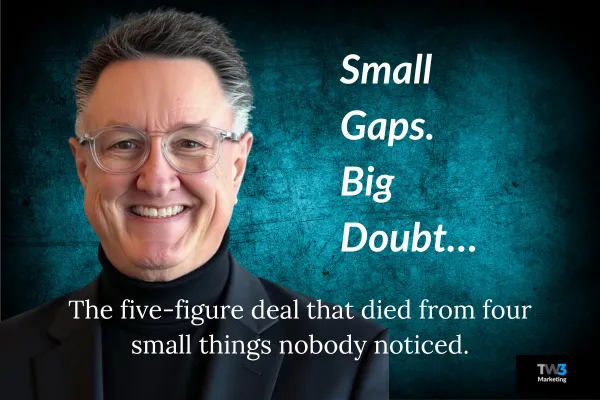
Small Gaps. Big Doubt.
The five-figure deal that died from four small things nobody noticed.
By Bobby Christy
Most deals don't fall apart because of one big mistake.
They stall because of small gaps.
The kind that feel harmless inside the business. The kind no one thinks to flag. The kind that, on their own, look like nothing — and stacked together, look like risk.
I saw it again last month.
Strong first call. Good questions. The prospect was leaning in. The conversation closed with what felt like real momentum. The proposal went out the same day.
Then nothing. No objection. No pushback. No request to revisit. Just silence.
When we walked the process backward, nothing looked technically wrong. The proposal was professional. The follow-up was sent on time. The offer was solid. The seller had done what most sellers would call good work.
But a few things felt unfinished.
The proposal described outcomes, but not timelines. The next step was implied, not stated. The follow-up email was friendly, but vague. The offer sounded solid in the meeting — but it was hard for the buyer to repeat out loud.
Four small gaps. Zero deal breakers. One stalled deal.
That's how trust leaks work. They don't announce themselves. They accumulate.
From the buyer's seat, each gap adds friction.
Not enough to say no. Just enough to slow down. The buyer doesn't open the proposal again as quickly. The follow-up email sits in the inbox a day longer. The internal champion has trouble explaining the offer to their boss, so the conversation stays on hold until "we have time to discuss it."
Each gap, on its own, is forgivable. The problem is that gaps don't subtract — they multiply. Three small leaks create more doubt than one big one. The buyer can't articulate it. They just feel less certain than they did when they hung up the phone.
And when momentum slows, confidence drops. Every time.
Write this down. When trust is strong, small gaps don't matter. When trust is fragile, small gaps become big doubts.
Where most leaders misread the situation.
This is the part owners miss. They look at a stalled deal and reach for the easiest explanation. They got busy. They're price-sensitive. They went on vacation. They're comparing options.
So they wait.
Waiting feels respectful. From the inside, it looks like the polite move. From the buyer's seat, it feels like risk. Silence creates space. Space gets filled with the questions the seller never hears.
What happens next?
How long will this take?
Is this the right decision right now?
What if this doesn't work?
Those questions don't show up in reply emails. They don't get raised on a follow-up call. They show up as hesitation. As one-day delays that turn into seven-day delays that turn into thirty-day silences.
If the seller didn't answer those questions inside the process, the buyer answers them alone. And buyers, alone with doubt, almost always answer them conservatively.
That's how a strong first call ends in a quiet no.
The fix isn't pressure. It's precision.
The instinct, when a deal goes quiet, is to push. Send another follow-up. Add another touchpoint. Sweeten the offer. Drop the price.
That instinct is wrong. Pressure into doubt creates more doubt. The fix is precision — answering the silent questions before the buyer has to ask them.
Every step in the process should answer one question without ambiguity: what happens next, and why is that safe?
That single question is the spine. Run every email, every call, every deliverable through it. If the answer to what happens next is unclear, the deal will stall there. If the answer to why is that safe is missing, the buyer will fill the gap with their own caution.
Precision closes gaps before doubt has room to grow.
What that looks like in practice.
Four moves separate the disciplined seller from the busy one.
Name the next step out loud. Don't assume the buyer knows. Don't bury it in the third paragraph of the follow-up email. Say it on the call: the next step is X, by Y date, and here's what we'll cover. Then put it in writing the same day.
Set expectations instead of assuming them. Timelines, deliverables, who owns what, how long each phase takes. Buyers don't get nervous about hard timelines. They get nervous about missing ones.
Follow up with purpose, not politeness. Every follow-up should carry weight — an answer to a question that came up, a relevant example, new information that moves the deal forward. Just touching base is the lowest-trust phrase in business. It tells the buyer the seller is anxious and has nothing new to add.
Make the decision easy to repeat. Most deals require an internal champion to sell the offer to someone else — a partner, a CFO, a board member. If the offer is hard to repeat out loud, it's hard to defend in a room you're not in. The cleaner the offer, the further it travels.
None of these are dramatic moves. Stacked together, they remove the silent questions before the buyer has to ask them.
Discipline beats brilliance.
This is the same pattern we measure on every Authority Score. Before the deal, the four surfaces — Google, LinkedIn, social, website — are scanned for do they all tell the same story? Inside the deal, the buyer is running the same test on the proposal, the follow-up, the next step, and the seller's behavior.
Same question. Is this consistent? Predictable? Steady?
Pass the test and the deal closes. Fail it and the deal goes quiet.
Buyers don't need more information. They need fewer unknowns. That's why discipline beats brilliance here. Not louder marketing. Not clever messaging. Not a sharper hook.
Just fewer gaps.
The takeaway.
Small gaps don't feel dangerous. That's exactly what makes them dangerous. They don't get flagged. They don't get fixed. They sit inside the process — invisible to the seller, obvious to the buyer — and they drain confidence one quiet inch at a time.
When trust is strong, small gaps don't matter. When trust is fragile, small gaps are everything.
The deals you're losing aren't being lost to a competitor. They're being lost to ambiguity.
Question to sit with this week: Where does your process rely on assumption instead of definition?
That's usually where decisions slow down.
FAQ
Q1: How can a deal stall if nothing actually went wrong? Because nothing has to go "wrong" for a deal to stall. Trust leaks come from things that go unfinished, not things that go wrong. A vague next step. An undefined timeline. A friendly but unfocused follow-up. None of those are mistakes. Stacked together, they create enough doubt to slow any decision.
Q2: What's the difference between pressure and precision in sales? Pressure pushes the buyer toward a decision. Precision removes the reasons they were hesitating in the first place. Pressure feels louder. Precision feels safer. Buyers move faster when they feel certain, not when they feel chased.
Q3: How do I know which gaps are killing my deals? Walk a stalled deal backward. Look at the proposal — does it set timelines, or only describe outcomes? Look at the last call — was the next step named out loud? Look at the follow-up — does it carry new information, or just check in? Look at the offer — could the buyer explain it cleanly to their boss? The first place that fails the test is usually where the deal started to stall.
Q4: Why is "make the offer easy to repeat" so important? Because most deals require an internal champion to sell the decision to someone else — a partner, a CFO, a board. If the offer can't be repeated cleanly out loud, it can't be defended in a room you're not in. The cleaner the offer, the further it travels. Hard-to-repeat offers die in conference rooms the seller never enters.
Q5: How long does it take to tighten a sales process? Less time than most owners think. Naming the next step, writing down timelines, swapping vague follow-ups for purposeful ones, and rewriting the offer so it's easy to repeat — those are one-week fixes. The next thirty days will tell you which deals had real interest behind the silence.
Build trust first. Growth follows. Text the word AUTHORITY to (678) 922-4561 and find out where your business really stands.
About Bobby Christy
Straight-Shooting Marketing Coach | CEO, TW3 Marketing | Author | Speaker | Host of Inside Pitch
Bobby Christy doesn’t teach marketing.
He teaches why people don’t trust you and how to fix it.
With over 40 years in sales and marketing, Bobby has built his reputation on a simple truth:
Most marketing doesn’t fail because of traffic.
It fails because of trust.
Today, that problem is bigger than ever.
Buyers aren’t just searching Google.
They’re asking AI who to trust.
And if your business doesn’t show up with real proof, clear positioning, and consistent authority…
you don’t get chosen.
That’s where Bobby comes in.
Through his Authority Framework™, Authority Score™, and Authority Audit™, he helps service-based businesses:
Turn invisible brands into recognized authorities
Find and fix the trust leaks killing conversions
Show up where AI and search engines are already looking
Build proof that makes prospects choose them faster
His work has helped businesses move from stuck… to scaling, with measurable growth in leads, conversations, and revenue.
At TW3 Marketing, the mission is simple:
Build trust first. Growth follows.
Text the word AUTHORITY to (678) 922-4561 and find out where your business really stands.
For Podcasters, Event Planners, and Speaking Bureaus
If you want a speaker your audience will actually remember and use, Bobby delivers.
No fluff. No theory. No recycled marketing talk.
Just real-world insight from four decades in the trenches, broken down so people can act on it immediately.
Bobby speaks on:
Why prospects don’t trust you (and how to fix it fast)
How AI is changing who gets chosen and who gets ignored
The Authority Framework™: becoming the obvious choice in your market
Why leads aren’t the problem and what actually is
His style is direct, conversational, and easy to follow.
It feels less like a keynote…
and more like someone finally explaining why things haven’t been working.
Audiences don’t just take notes.
They leave seeing their business differently and knowing what to do next.
If your audience is made up of business owners, sales teams, or leaders trying to stand out in a crowded market, Bobby is the speaker who will connect.
To book Bobby Christy for your podcast, event, or stage, reach out today.