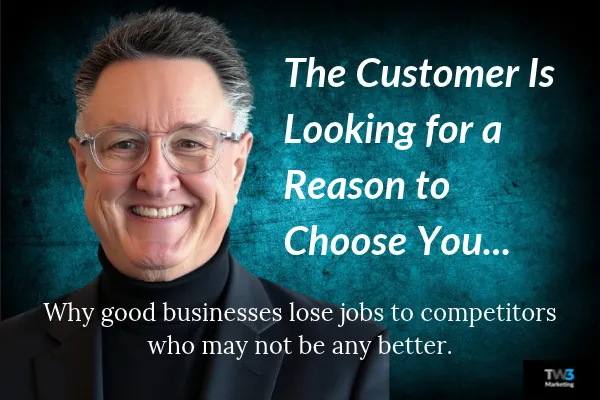
The Customer Is Looking for a Reason to Choose You
Why good businesses lose jobs to competitors who may not be any better.
By Bobby Christy
Ever lose a job to a competitor you know isn't better than you?
Your price was fair. Your experience was solid. You knew you could do excellent work. And the customer hired someone else.
Most owners assume it was price. Sometimes it was. But there's another possibility worth your attention.
The other business gave the customer more reasons to trust them.
Why does the better business lose so often?
Because customers can't compare the work they haven't seen. They compare what's in front of them.
Customers are shopping for confidence.
Think about the last time you hired someone to fix your roof, service your car, or handle something important with your money. You didn't take the first name you found. You looked at options. You wanted to know who could solve the problem without creating another one.
Your customers do the same thing. They aren't just looking for someone who offers the service. They're looking for someone they believe will deliver what they promise.
And most of that decision happens before they ever contact you.
Five decisions stand between you and the job.
Dan Kennedy describes five steps people move through when they buy. They explain a lot about who wins.
1. They recognize a problem. The roof leaks. The AC quits. Growth stalls. They aren't looking for you yet. They're looking for an answer.
2. They decide what kind of solution makes sense. Repair or replace? Hire a pro or do it themselves? They choose what they need before they choose who provides it.
3. They choose who they believe can do the job. This is where competition begins. Every business says it's experienced, professional, and dependable. When everyone says the same thing, those words stop meaning anything. So the customer looks for evidence.
4. They decide whether the price is worth paying. Strong evidence can make a higher price feel justified. When they can't see a difference between you and the next company, price becomes the tiebreaker.
5. They look for a reason to act now. Even interested customers hesitate. Another estimate? Wait a month? Businesses that answer questions and make the next step easy give people the confidence to move.
Write this down. Your marketing has to help customers through all five decisions, not just list what you offer.
Your website may be answering the wrong questions.
In a Trust & Authority Audit, one thing we examine is whether a business gives people enough to make a confident decision. There's a real difference between describing your services and proving you can deliver them.
A contractor's site lists roofing, siding, and remodeling. Does it show finished projects, customer experiences, and proof the company stands behind its work?
An insurance agency explains its policies. Does it help a family understand why they should trust that agency with what matters most?
A landscaping company posts beautiful photos. Can a property manager tell whether that company has the experience and crews to handle a large site?
Customers ask these questions even when they never say them out loud.
Your services explain what you do. Your proof helps them believe you can do it.
Good work doesn't always speak for itself.
Picture two contractors bidding the same remodel. Both have years of experience. Both offer similar services. Both send reasonable estimates.
The first has a website with a service list, a phone number, and a few lines about quality workmanship. The second shows recent projects, customer reviews, before-and-after photos, and answers to the questions homeowners actually ask.
Which one would you feel better hiring?
We don't know which does better work. The first might be the better choice. But the second gives the customer more reasons to believe it.
That's the problem for a lot of good businesses. Years of skill and a solid reputation, mostly invisible to someone meeting them for the first time. You can't expect customers to trust what they can't see.
More leads won't fix a trust gap.
Here's where owners make an expensive mistake. Not enough calls, so they buy more advertising. Losing estimates, so they chase more leads. Website underperforming, so they rebuild it.
Sometimes those are exactly the right moves.
But what if people are finding you, comparing you with three competitors, and leaving because they don't see enough reasons to choose you? More advertising won't solve that. It sends more people to a business that hasn't yet given them confidence to take the next step.
We've seen the value of making trust visible in our own client work. With Sungenis Insurance Agency, we built a stronger customer review presence, and the agency reached 48 reviews. That doesn't prove every new customer chose them because of those reviews. It does mean prospects have more evidence in front of them when they decide.
Try this before you spend another dollar.
Open your website and pretend you've never heard of your company. No relationship with the owner. No experience with the work. You're a customer with a problem, and you've found your business next to three competitors.
Then check the places a customer checks: your site, your Google profile, your LinkedIn, your social pages. Do they tell the same story?
Can I quickly see what makes this company different? Is there evidence customers are satisfied? Are there examples of finished work? Are my biggest questions answered?
Most important: does it give someone enough confidence to choose you over the other three?
If you're not sure, find out before you raise your ad budget. Attracting attention and earning trust are two different jobs. Your marketing has to do both.
Find out what your customers see.
At TW3 Marketing, we built the Trust & Authority Audit to show service business owners how they appear to potential customers. For $497, we examine the signals that shape how people find, evaluate, and decide whether to trust you. We show what's working, where proof is missing, and which fixes deserve attention first.
If you hire TW3 Marketing to implement the recommendations, we credit the full $497 toward that work.
Your competitors may not be better than you. They may just be making it easier for customers to trust them.
Until next week,
Bobby
If this earned you a few minutes of your time this week, the best thank-you is forwarding this to a friend. We’re building this slowly and deliberately, one reader at a time.
FAQ
Q1: Why do customers choose a competitor who isn't any better? Because customers can't see the quality of work they haven't experienced. They compare what's visible. The business that shows more proof gives them more reasons to believe it can deliver, and that often decides the job.
Q2: What are the five decisions customers make before they buy? Following Dan Kennedy's framework, they recognize a problem, decide what kind of solution makes sense, choose who they believe can do the job, decide whether the price is worth paying, and look for a reason to act now.
Q3: Is price the main reason I lose estimates? Sometimes. But when customers can't see a meaningful difference between businesses, price becomes the tiebreaker by default. When one business provides strong evidence of its ability, a higher price can feel justified.
Q4: Will more advertising fix a lack of trust? Not on its own. If people are finding your business, comparing it with competitors, and leaving, more advertising sends more of them to the same gap. Check what your business shows customers before you increase your budget.
Q5: What is the TW3 Marketing Trust & Authority Audit? A $497 review of the signals that shape how people discover, evaluate, and trust your business. It identifies what's working, where proof is missing, and which improvements to make first. If you hire TW3 Marketing to implement the recommendations, the full $497 is credited toward that work.
About Bobby Christy
Straight-Shooting Marketing Coach | CEO, TW3 Marketing | Author | Speaker | Host of Inside Pitch
Bobby Christy doesn’t teach marketing.
He teaches why people don’t trust you and how to fix it.
With over 40 years in sales and marketing, Bobby has built his reputation on a simple truth:
Most marketing doesn’t fail because of traffic.
It fails because of trust.
Today, that problem is bigger than ever.
Buyers aren’t just searching Google.
They’re asking AI who to trust.
And if your business doesn’t show up with real proof, clear positioning, and consistent authority…
you don’t get chosen.
That’s where Bobby comes in.
Through his Authority Framework™, Authority Score™, and Authority Audit™, he helps service-based businesses:
Turn invisible brands into recognized authorities
Find and fix the trust leaks killing conversions
Show up where AI and search engines are already looking
Build proof that makes prospects choose them faster
His work has helped businesses move from stuck… to scaling, with measurable growth in leads, conversations, and revenue.
At TW3 Marketing, the mission is simple:
Build trust first. Growth follows.
Text the word AUTHORITY to (678) 922-4561 and find out where your business really stands.
For Podcasters, Event Planners, and Speaking Bureaus
If you want a speaker your audience will actually remember and use, Bobby delivers.
No fluff. No theory. No recycled marketing talk.
Just real-world insight from four decades in the trenches, broken down so people can act on it immediately.
Bobby speaks on:
Why prospects don’t trust you (and how to fix it fast)
How AI is changing who gets chosen and who gets ignored
The Authority Framework™: becoming the obvious choice in your market
Why leads aren’t the problem and what actually is
His style is direct, conversational, and easy to follow.
It feels less like a keynote…
and more like someone finally explaining why things haven’t been working.
Audiences don’t just take notes.
They leave seeing their business differently and knowing what to do next.
If your audience is made up of business owners, sales teams, or leaders trying to stand out in a crowded market, Bobby is the speaker who will connect.
To book Bobby Christy for your podcast, event, or stage, reach out today.