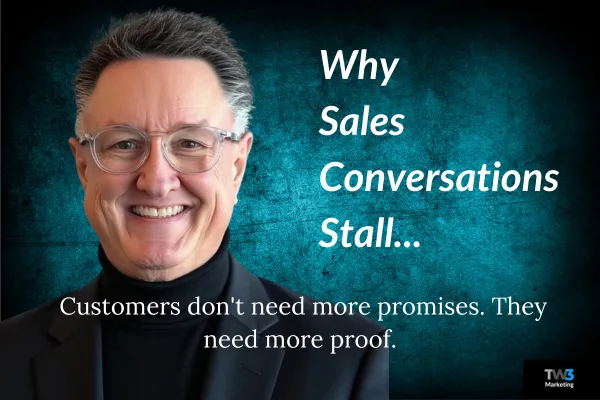
Why Sales Conversations Stall (Even When Customers Like You)
The call went great. Then silence. Here's what actually happened.
By Bobby Christy
Every business owner has lived this one.
A prospect calls. The conversation flows. They ask sharp, thoughtful questions. They sound genuinely interested. You hang up thinking, I think we've got this one.
Then nothing. No call. No email. No decision. They simply disappear.
And almost everyone reaches for the same explanation. We must have been too expensive. Sometimes that's true. But after running Authority Audits for service businesses month after month, I've stopped believing price is the usual culprit. Something quieter happens first.
The prospect stops finding enough proof to keep moving forward.
Write this down. Most conversations don't die over price. They stall the moment a buyer runs out of evidence.
You already know how this works — because you do it too.
Think about the last real decision you made. A contractor. An attorney. A CPA. A financial advisor.
Did you hire the first person you talked to? Almost certainly not. You started gathering evidence. You read the reviews. You opened the website. You searched Google. You checked LinkedIn. Maybe you asked someone you trusted.
You weren't hunting for another promise. You were hunting for proof that you were about to make the right call.
That's exactly what your customers are doing right now. Every one of them is quietly trying to answer a single question: Have I seen enough to stop looking? Until the answer is yes, they keep looking.
The pattern that shows up in almost every audit.
Here's what surprises people about the audits. The businesses we review are usually excellent. Years of experience. Happy customers. Strong work. Real reputations earned the hard way.
The problem is almost never a lack of proof. The problem is that the proof isn't visible.
No recent testimonials. Few case studies. No educational articles. No customer success stories. A Google Business Profile that hasn't been touched in a year. A LinkedIn profile frozen months in the past.
The proof exists. The customer just can't find it. And when people can't find proof, they don't assume the best. They assume the worst, quietly, and they keep searching — usually until they land on a competitor who made their evidence easier to see.
Silence isn't neutral. To a cautious buyer, a gap where a review should be reads as a warning. An empty case-studies page reads as maybe they don't have any. A profile that hasn't moved in a year reads as maybe they're not paying attention anymore. None of it may be true. It doesn't matter. In the absence of proof, people fill the space with doubt.
Read that again. You may not be losing to a better business. You may be losing to a more visible one.
The expensive mistake owners make next.
When conversations start to slow, most owners reach for the same lever. More leads. More advertising. More SEO. More social. More traffic.
But pouring more people into the top of the funnel does nothing if the people already talking to you can't find a reason to move forward. You're not fixing the leak. You're just running more water past it. And it's expensive water — every one of those new leads costs you time and money to earn, only to stall at the same invisible wall as the last one.
The better question was never how do I get more leads? The better question is have I given people enough proof to trust me?
Those are two very different questions. One is about volume. The other is about confidence. And only one of them keeps conversations alive.
What's changed, and what never will.
I've watched buying behavior shift for decades. Newspaper ads gave way to the Yellow Pages. The Yellow Pages gave way to websites. Websites gave way to Google. And now Google is giving way to AI.
One thing has never moved. People still need to feel safe before they decide.
What's changed is that they no longer take a business at its word. They verify it. They look for reviews, testimonials, videos, articles, recommendations, Google Business Profile activity, LinkedIn activity. Evidence.
And here's where the four surfaces matter. Your Google profile. Your LinkedIn. Your social. Your website. A careful buyer checks all four — and now AI checks all four too, in seconds, at scale. Do they tell the same story? Same business? Same proof, everywhere I look? When those surfaces line up, doubt has nowhere to sit. When they don't, every gap becomes one more reason to wait.
Every review strengthens your case. Every testimonial, every helpful article, every customer story, every video strengthens your case. Alone, each one looks small. Stacked together, they become the reason someone chooses you instead of the business down the street.
The question that actually matters.
So if your conversations have been slowing down, resist the urge to ask how do I generate more leads?
Ask the harder one instead. If I were seeing my own business for the first time today, would I find enough proof to confidently choose me?
Be honest with the answer. Because that's the exact question your next customer is trying to settle — and they're settling it whether or not you're in the room.
The good news is simple. You don't need to become a different business. You're already good, and your customers already know it. You just have to make that goodness visible, in the places people and machines actually look.
Stop chasing more conversations. Start removing the doubt in the ones you already have.
"Conversations don't stall because customers stop liking you. They stall because customers stop finding enough proof to choose you."
— Bobby Christy, Founder, TW3 Marketing
FAQ
Q1: Why do sales conversations stall even when the customer likes you? Because being liked was never the deciding factor — feeling safe is. A prospect can enjoy the call, respect your experience, and still walk away, because underneath the good conversation they're quietly asking have I seen enough to choose these people? When the answer is no, they don't say so. They just go quiet and keep looking. Price gets the blame because it's the easy explanation, but more often the real issue is that the buyer couldn't find enough visible evidence to feel confident. Liking you gets you the conversation. Proof is what closes it.
Q2: What actually counts as proof to a prospect? Anything a stranger can find that shows you've done this well before. Recent reviews. Testimonials. Case studies and customer success stories. Educational articles and videos. Referrals and recommendations. An active, up-to-date Google Business Profile. A LinkedIn profile that looks current instead of abandoned. Individually each piece seems minor. Stacked together they answer the buyer's real question — can I trust these people? — before you ever say another word. Proof isn't bragging. It's the evidence that lets a cautious person stop worrying and move forward.
Q3: Isn't a strong reputation enough on its own? Only if people can actually see it. A great reputation that lives in the memories of past customers and nowhere online can't help the prospect who's checking you out at 9 p.m. before they call. Today's buyer verifies before they trust, and so does AI. If your work is excellent but invisible — no recent reviews, no content, a stale profile — you're asking a stranger to take your word for something they have no way to confirm. Reputation only works when it's documented where people look for it.
Q4: How do I know if my proof is missing or just invisible? Look at your business the way a first-time customer would. Open a private browser and search your name. Pull up your Google Business Profile, your LinkedIn, your social pages, and your website. Ask yourself honestly: would a skeptical stranger quickly find enough evidence to feel confident — or would they keep searching? Notice what's missing, what's outdated, and whether the four surfaces tell the same story. That gap between how good you actually are and how good you look online is almost always where conversations are stalling.
Q5: Should I fix my proof before spending more on lead generation? In most cases, yes. Pouring more leads into a funnel that isn't converting just spends money to watch more people hesitate at the same spot. If prospects are engaging but not deciding, the bottleneck usually isn't volume — it's evidence. Fixing your proof first means every new lead you generate afterward lands on a business that already looks trustworthy, so more of those conversations actually move forward. Build the proof, then turn up the traffic. Do it in that order and the same ad spend works harder.
Build trust first. Growth follows. Text the word AUTHORITY to (678) 922-4561 and find out where your business really stands.
About Bobby Christy
Straight-Shooting Marketing Coach | CEO, TW3 Marketing | Author | Speaker | Host of Inside Pitch
Bobby Christy doesn’t teach marketing.
He teaches why people don’t trust you and how to fix it.
With over 40 years in sales and marketing, Bobby has built his reputation on a simple truth:
Most marketing doesn’t fail because of traffic.
It fails because of trust.
Today, that problem is bigger than ever.
Buyers aren’t just searching Google.
They’re asking AI who to trust.
And if your business doesn’t show up with real proof, clear positioning, and consistent authority…
you don’t get chosen.
That’s where Bobby comes in.
Through his Authority Framework™, Authority Score™, and Authority Audit™, he helps service-based businesses:
Turn invisible brands into recognized authorities
Find and fix the trust leaks killing conversions
Show up where AI and search engines are already looking
Build proof that makes prospects choose them faster
His work has helped businesses move from stuck… to scaling, with measurable growth in leads, conversations, and revenue.
At TW3 Marketing, the mission is simple:
Build trust first. Growth follows.
Text the word AUTHORITY to (678) 922-4561 and find out where your business really stands.
For Podcasters, Event Planners, and Speaking Bureaus
If you want a speaker your audience will actually remember and use, Bobby delivers.
No fluff. No theory. No recycled marketing talk.
Just real-world insight from four decades in the trenches, broken down so people can act on it immediately.
Bobby speaks on:
Why prospects don’t trust you (and how to fix it fast)
How AI is changing who gets chosen and who gets ignored
The Authority Framework™: becoming the obvious choice in your market
Why leads aren’t the problem and what actually is
His style is direct, conversational, and easy to follow.
It feels less like a keynote…
and more like someone finally explaining why things haven’t been working.
Audiences don’t just take notes.
They leave seeing their business differently and knowing what to do next.
If your audience is made up of business owners, sales teams, or leaders trying to stand out in a crowded market, Bobby is the speaker who will connect.
To book Bobby Christy for your podcast, event, or stage, reach out today.