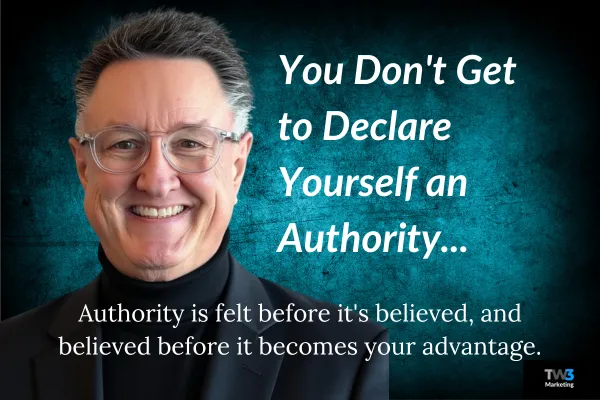
You Don't Get to Declare Yourself an Authority
Authority is felt before it's believed, and believed before it becomes your advantage.
By Bobby Christy
There's something strange happening in marketing.
Everybody is an expert. Everybody is a leader. Everybody is trusted. And lately, everybody seems to be an authority.
There's just one problem.
You don't get to decide that. Your prospects do.
You can put "industry expert" in your LinkedIn headline. You can call yourself a "trusted leader" on your website. You can tell people you've been serving customers for twenty years. None of those things automatically create authority.
Because authority is felt, not claimed. And people feel it much faster than most businesses realize.
Your prospect is already judging you.
Think about the last time someone recommended a business to you. What did you do?
You looked them up. You visited the website. You checked the reviews. You glanced at their Google presence. You read a few posts. You searched the owner's name. Maybe today you even asked ChatGPT or Gemini about them.
You were looking for something. Not the cheapest price. Not the longest list of services. You were trying to answer a much simpler question. Do I believe these people?
Write this down. That decision starts forming almost immediately.
A professional website says something. So does an outdated one. Fifty strong reviews say something. So do three reviews from 2021. Helpful content says something. So does six months of silence. Clear explanations say something. So do vague promises like "quality service" and "customer satisfaction."
Every signal adds to the feeling. Or quietly subtracts from it.
This is where good businesses get hurt.
One pattern keeps showing up in our Authority Audits, and it's a frustrating one.
The business is almost always better than its online presence suggests. The owner has real experience. Customers love them. They know their craft. They've solved hundreds, sometimes thousands, of real problems.
But when someone researches them online, most of that evidence is missing.
The expertise exists. The proof doesn't.
That's an authority gap. And here's the hard part. Your prospect doesn't know the gap is there. They can't grade you on experience they never see. They simply judge what's in front of them.
Which means a less capable competitor can look like the safer choice, for one reason only. They did a better job showing the evidence.
That's expensive.
Authority changes the sale.
Most businesses think marketing is about getting attention. More traffic. More clicks. More followers. More leads.
Those things matter. But getting noticed and getting chosen are two very different problems.
When authority is weak, the salesperson has to make up the difference. They explain more. They defend the price. They answer more objections. They follow up more often. And they hear the same three lines. Let me think about it. We're talking to a few other companies. Can you send me some information?
Strong authority changes that conversation before it ever happens.
The prospect arrives already knowing something about you. They've seen the reviews. They've read your thinking. They've found consistent information wherever they looked. Other people appear to trust you. Search engines understand who you are. And increasingly, AI systems can connect your business to the exact problems you solve.
By the time that prospect talks to you, you're no longer starting at zero. Trust has already started doing the selling.
That's the competitive advantage.
Here's where this gets bigger.
Your competitors can copy your services. They can undercut your price. They can rebuild their website. They can lift your offer. They can even imitate your content.
What they cannot easily copy is years of accumulated trust.
Reviews. Experience. Case studies. Consistent expertise. Third-party mentions. Community reputation. Helpful content. A recognizable point of view. A digital presence that tells the same story everywhere someone looks.
Those signals compound.
One review doesn't create authority. One article doesn't create authority. One great website doesn't create authority. But when all of it reinforces one another, something shifts. The prospect starts to feel it. These are the people I should talk to.
That's authority. And once it happens consistently, it stops being a marketing idea. It becomes a competitive advantage no one can buy their way past.
The question I'd ask this week.
Don't ask, Are we an authority? That's your opinion, and your opinion was never the one being measured.
Ask this instead. If someone knew nothing about us and researched us today, what would make them believe we're the right choice?
Then go look. Actually look.
Search your business. Search your name. Read your reviews the way a stranger would. Visit your website like you've never seen it before. Check your four surfaces, Google, LinkedIn, social, and your website, and see whether they tell the same story. Look at what you've published lately.
See whether your expertise is obvious, or whether someone has to take your word for it.
Because the market can't give you credit for evidence it can't find.
You don't get to declare yourself an authority. You build the evidence. You make the evidence easy to find. Then you let the market decide.
And when enough people reach the same conclusion, something powerful happens. You stop chasing attention. You start becoming the obvious choice.
"The market can't give you credit for evidence it can't find."
— Bobby Christy, Founder, TW3 Marketing
FAQ
Q1: Can I just call myself an authority in my industry? You can, but it won't do the work you want it to. Authority isn't a title you assign yourself. It's a feeling your prospect forms while researching you. You can write "industry expert" in your headline and "trusted leader" on your website, and none of it counts until the evidence backs it up. People believe what they can see and verify, not what you announce. The claim isn't the authority. The proof is.
Q2: What actually creates authority if claiming it doesn't? Accumulated, consistent evidence across the places people look. Current reviews. Real case studies. Helpful content that shows your thinking. A recognizable point of view. Third-party mentions. A digital presence that tells the same story on Google, LinkedIn, social, and your website. No single piece creates authority. But when all of it reinforces one another, the prospect starts to feel you're the right choice. That feeling is authority, and it compounds over time.
Q3: What is an "authority gap"? It's the distance between how good your business actually is and how good it looks online. Most owners have deep experience and happy customers, but when someone researches them, that evidence is missing. The expertise exists; the proof doesn't. The danger is that your prospect can't see the gap. They only judge what's in front of them, so a less capable competitor who shows more evidence can look like the safer bet. Closing that gap is often faster and cheaper than chasing more leads.
Q4: How does stronger authority make sales easier? When authority is weak, your salesperson has to make up the difference by explaining more, defending the price, and answering more objections, only to hear "let me think about it." Strong authority changes the conversation before it starts. The prospect arrives already knowing your reviews, your thinking, and your experience. Trust has already begun doing the selling, so you're not starting at zero. You spend less energy convincing and more time helping the right people decide.
Q5: How do I find out where my authority actually stands? Look at your business the way a first-time customer would. Search your business name and your own name. Read your reviews like a stranger. Visit your website as if you've never seen it. Check whether your four surfaces, Google, LinkedIn, social, and website, tell the same story. Ask one honest question: if I knew nothing about this business, what would make me believe it's the right choice? A structured Authority Audit does this systematically and turns the gaps into a short, practical list of fixes.
About Bobby Christy
Straight-Shooting Marketing Coach | CEO, TW3 Marketing | Author | Speaker | Host of Inside Pitch
Bobby Christy doesn’t teach marketing.
He teaches why people don’t trust you and how to fix it.
With over 40 years in sales and marketing, Bobby has built his reputation on a simple truth:
Most marketing doesn’t fail because of traffic.
It fails because of trust.
Today, that problem is bigger than ever.
Buyers aren’t just searching Google.
They’re asking AI who to trust.
And if your business doesn’t show up with real proof, clear positioning, and consistent authority…
you don’t get chosen.
That’s where Bobby comes in.
Through his Authority Framework™, Authority Score™, and Authority Audit™, he helps service-based businesses:
Turn invisible brands into recognized authorities
Find and fix the trust leaks killing conversions
Show up where AI and search engines are already looking
Build proof that makes prospects choose them faster
His work has helped businesses move from stuck… to scaling, with measurable growth in leads, conversations, and revenue.
At TW3 Marketing, the mission is simple:
Build trust first. Growth follows.
Text the word AUTHORITY to (678) 922-4561 and find out where your business really stands.
For Podcasters, Event Planners, and Speaking Bureaus
If you want a speaker your audience will actually remember and use, Bobby delivers.
No fluff. No theory. No recycled marketing talk.
Just real-world insight from four decades in the trenches, broken down so people can act on it immediately.
Bobby speaks on:
Why prospects don’t trust you (and how to fix it fast)
How AI is changing who gets chosen and who gets ignored
The Authority Framework™: becoming the obvious choice in your market
Why leads aren’t the problem and what actually is
His style is direct, conversational, and easy to follow.
It feels less like a keynote…
and more like someone finally explaining why things haven’t been working.
Audiences don’t just take notes.
They leave seeing their business differently and knowing what to do next.
If your audience is made up of business owners, sales teams, or leaders trying to stand out in a crowded market, Bobby is the speaker who will connect.
To book Bobby Christy for your podcast, event, or stage, reach out today.