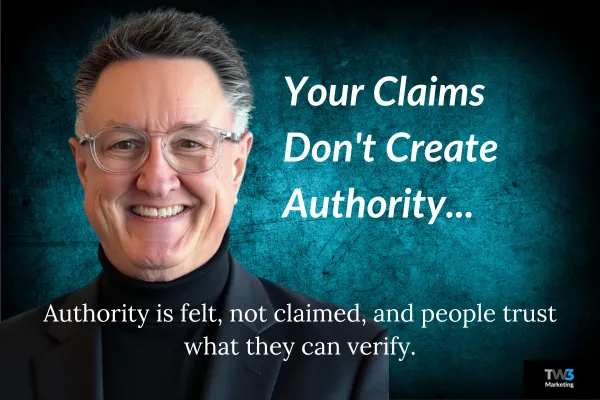
Your Claims Don’t Create Authority
Authority is felt, not claimed, and people trust what they can verify far more than what you tell them.
By Bobby Christy
Your customer doesn't have to believe what you say about your business anymore.
They can check.
That may be one of the biggest changes in marketing over the past twenty years. There was a time when a business controlled most of the story. You built a website, ran some ads, printed a brochure, and told people why they should choose you.
Today, the customer has the other side of the story.
They can read your reviews, search your name, look at your Google presence, check your social media, visit your website, and look up the owner. They can see what other people have said about you. And increasingly, they can ask AI.
That creates a problem for one of the oldest habits in marketing. Making claims and expecting people to believe them.
Everybody says they're great.
Look at enough business websites and you start seeing the same words.
Trusted. Experienced. Professional. Customer-focused. Industry leader. Quality service.
I'm not saying those things aren't true. I'm saying they don't mean much by themselves, because your competitors are saying the exact same things.
When was the last time you visited a plumber's website and read, "We're usually late, our work is average, and customer service isn't really our thing"?
You haven't. Every plumber is reliable. Every HVAC company cares. Every advisor is experienced. Every consultant gets results. At least according to their websites.
Write this down. A claim is marketing. Evidence turns it into authority.
People have learned to check the story.
Someone recommends a company to you. What do you do?
You Google them. You read the reviews, visit the website, check the owner, maybe glance at LinkedIn or Facebook.
Here's the part worth noticing. You're not looking for a reason to hire them yet. You're looking for a reason to believe them.
That difference is everything.
The business may say it has great service. You want to see customers saying it. The owner may say she's an expert. You want to see the expertise. The website may say the company has been trusted for decades. You want to see that other people actually trusted it.
The business no longer controls that conversation. The buyer is checking the story. And when everything lines up, the buyer starts feeling confident before they ever speak to anyone.
That's authority.
Try the No-Claims Test.
Here's a simple test I use when I look at a business online.
If we removed everything the company says about itself, what would be left that makes me trust it?
Call it the No-Claims Test. Take away "trusted." Remove "experienced." Delete "industry leader," "best service," and every other claim.
What's left?
Reviews. Results. Customer stories. Case studies. Credentials. Third-party mentions. Years of visible work.
For some businesses, plenty remains. For others, almost nothing does. And yet those two businesses may be equally good at what they do.
That's the Authority Gap.
I see this in Authority Audits all the time.
Being a great business and looking like a great business online are two very different things.
One of our clients is a perfect example. They're an independent agency in South Jersey, serving their community since 1963. More than sixty years in business. You don't last that long doing things wrong.
When we started, they had ten Google reviews.
That number didn't tell the truth about the business. It told the truth about how much of the business's reputation had made it online. There's a big difference.
We didn't manufacture authority for them. They already had it. Our job was to make the evidence visible. Today they have forty-eight reviews. We rebuilt the website, built a consistent social presence, started publishing useful content, and turned six decades of real-world trust into something a stranger could actually find.
The business didn't suddenly become more trustworthy. The proof finally caught up with the reputation.
AI doesn't know you're good.
People are using ChatGPT, Gemini, and Google's AI results to decide which businesses to trust. And here's what many owners haven't caught up with yet.
AI doesn't know you're good. It knows what it can find about you.
You may have thirty years of experience and hundreds of happy customers. But if almost none of that exists online, how is an AI engine supposed to know?
A business with five years of experience and strong, visible proof can look more authoritative than a business with thirty years and very little. Not because the younger one is better. Because its authority is easier to verify.
That's why SEO, reviews, content, social, your website, and your business profiles aren't separate tactics. Together they build one thing. Evidence. And that evidence answers the only question that matters. Why should I believe you?
More isn't necessarily better.
Building authority doesn't mean piling up as much as possible online.
Fifty blog posts don't make you an authority. Two hundred reviews don't prove everything. Volume and evidence are not the same thing.
The evidence has to support the conclusion you want someone to reach. If you say you're experienced, show the experience. If you say customers trust you, show what they say. If you say you get results, show the result.
You're no longer asking people to take your word for it. You're giving them enough to reach the conclusion themselves. And that conclusion is more powerful than anything you could put in a headline.
The best authority is discovered.
There's a reason a recommendation carries so much weight. Someone else reached the conclusion for us. Nobody announced it. Someone else decided it.
That's what your marketing should be building toward. Your website, reviews, content, Google presence, and social profiles, all four surfaces telling the same story, should give a stranger enough to decide on their own.
We don't create your authority. We uncover it, document it, and make it impossible to miss.
So here's the question I'd ask this week. If you stopped telling people you were good at what you do, is there enough evidence online for them to figure it out anyway?
If the answer is yes, you're building authority. If the answer is no, you probably don't have a marketing problem.
You have an evidence problem.
And if they can't find the proof, they can't feel the authority.
"A claim is marketing. Evidence turns it into authority."
— Bobby Christy, Founder, TW3 Marketing
FAQ
Q1: If I can't just claim authority, what actually creates it? Verifiable evidence, spread across the places people look. Current reviews, real customer stories, case studies, credentials, third-party mentions, and years of visible work. A claim like "trusted" or "experienced" is marketing; it means little because your competitors say the same thing. Authority forms when a stranger checks you out and everything lines up. You're not asking people to take your word for it, you're giving them enough proof to reach the conclusion themselves.
Q2: What is the "No-Claims Test"? It's a fast way to see your business the way a buyer does. Remove everything the company says about itself, "trusted," "industry leader," "best service," every self-description, and ask what's left that would still make someone believe you. Reviews? Results? Case studies? Third-party mentions? For some businesses, plenty remains. For others, almost nothing does. Whatever survives that test is your real authority. Everything else is just a claim waiting to be verified.
Q3: What is the "Authority Gap"? It's the distance between how good your business actually is and how good it looks online. Most owners have deep experience and loyal customers, but when someone researches them, most of that evidence is missing. Two equally good businesses can look completely different online purely because one made its proof easy to find. The danger is that your prospect can't see the gap, they only judge what's in front of them, so a less capable competitor with more visible evidence can look like the safer choice.
Q4: Why does AI matter for my business's authority? Buyers are increasingly asking ChatGPT, Gemini, and Google's AI results which businesses to trust. Those engines don't know you're good; they only know what they can find about you. If thirty years of experience and hundreds of happy customers live nowhere online, an AI engine has nothing to go on. A newer competitor with strong, visible proof can appear more authoritative simply because its evidence is easier to verify. Making your proof findable is now part of getting chosen.
Q5: Doesn't more content and more reviews automatically build authority? No. Volume and evidence are not the same thing. Fifty blog posts and two hundred reviews don't prove anything on their own. The evidence has to support the specific conclusion you want someone to reach. If you say you're experienced, show the experience. If you say customers trust you, show what they say. If you say you get results, show the result. A smaller amount of proof that clearly backs your claims beats a large pile of content that doesn't.
About Bobby Christy
Straight-Shooting Marketing Coach | CEO, TW3 Marketing | Author | Speaker | Host of Inside Pitch
Bobby Christy doesn’t teach marketing.
He teaches why people don’t trust you and how to fix it.
With over 40 years in sales and marketing, Bobby has built his reputation on a simple truth:
Most marketing doesn’t fail because of traffic.
It fails because of trust.
Today, that problem is bigger than ever.
Buyers aren’t just searching Google.
They’re asking AI who to trust.
And if your business doesn’t show up with real proof, clear positioning, and consistent authority…
you don’t get chosen.
That’s where Bobby comes in.
Through his Authority Framework™, Authority Score™, and Authority Audit™, he helps service-based businesses:
Turn invisible brands into recognized authorities
Find and fix the trust leaks killing conversions
Show up where AI and search engines are already looking
Build proof that makes prospects choose them faster
His work has helped businesses move from stuck… to scaling, with measurable growth in leads, conversations, and revenue.
At TW3 Marketing, the mission is simple:
Build trust first. Growth follows.
Text the word AUTHORITY to (678) 922-4561 and find out where your business really stands.
For Podcasters, Event Planners, and Speaking Bureaus
If you want a speaker your audience will actually remember and use, Bobby delivers.
No fluff. No theory. No recycled marketing talk.
Just real-world insight from four decades in the trenches, broken down so people can act on it immediately.
Bobby speaks on:
Why prospects don’t trust you (and how to fix it fast)
How AI is changing who gets chosen and who gets ignored
The Authority Framework™: becoming the obvious choice in your market
Why leads aren’t the problem and what actually is
His style is direct, conversational, and easy to follow.
It feels less like a keynote…
and more like someone finally explaining why things haven’t been working.
Audiences don’t just take notes.
They leave seeing their business differently and knowing what to do next.
If your audience is made up of business owners, sales teams, or leaders trying to stand out in a crowded market, Bobby is the speaker who will connect.
To book Bobby Christy for your podcast, event, or stage, reach out today.