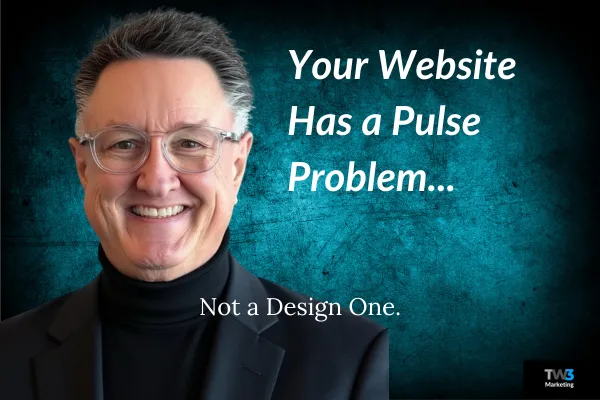
Your Website Has a Pulse Problem, Not a Design One
Why "looking professional" stopped being enough — and what AI is actually measuring now.
By Bobby Christy
Open ten websites in your industry.
Same clean layout. Same professional colors. Same stock photos of people in headsets. Same lines you've read a hundred times. We care. We're different. We put customers first.
Nothing wrong with any of them.
Nothing memorable about any of them either.
That's the part most owners miss. The website isn't broken. The website is fine. The problem is that fine doesn't move anybody anymore. Visitors land, glance, and leave. No reaction. No emotion. No reason to stay. Twelve seconds in, they're gone — and the owner is still convinced the issue must be the headline, the color palette, or the call-to-action button.
It isn't.
It's the silence. A website that triggers zero reaction is a website that fails the only test that matters anymore.
What AI is actually measuring.
This is the shift most operators haven't caught up to yet.
Search isn't a keyword game anymore. AI doesn't just read your site. It watches what happens after a visitor lands on it. Did they stay? Did they scroll? Did they click something? Did they come back? Did they engage with your business somewhere else after they left?
Those are behavior signals. They tell AI whether real humans found you useful or forgettable.
Google, ChatGPT, Perplexity, AI Overviews — they're all running a quiet question in the background. Which businesses do people actually trust? They answer it by watching what people do. Reviews. Engagement. Watch time. Comments. Responsiveness. Repeat visits.
Write this down. AI isn't grading your website on what it says. It's grading you on how humans react to it.
That's the new game. Most businesses are still playing the old one.
The lie that's keeping owners stuck.
The lie sounds like this. If our website looks professional, we're fine.
Professional used to be the differentiator. Now it's the floor. Every owner has access to clean templates, AI-generated copy, stock photography, and decent designers. The result is an internet full of businesses that look identical and sound identical.
When everything feels the same, nothing stands out. Nothing stands out, nothing gets remembered. Nothing gets remembered, nothing gets recommended. Not by humans. Not by AI.
That's why so many owners feel invisible right now. They're working hard. Posting. Updating. Refreshing the homepage. Trying tactic after tactic. The frustration is real and the effort is real. But the lever they're pulling isn't connected to anything anymore.
The lever AI cares about is human reaction. And most websites are emotionally flat.
Most websites have no pulse.
Read this line and ask yourself if it sounds like your page.
We're committed to excellence. We put our customers first. We deliver quality service you can count on.
Everybody says that. So nobody believes it.
That kind of language doesn't create tension. Doesn't create curiosity. Doesn't show proof. Doesn't show personality. A visitor reading it has nothing to react to, nothing to disagree with, nothing to remember. They skim and leave.
When enough visitors do that, AI gets the message. This page doesn't earn attention. Down the rankings it goes. Out of the recommendations it falls.
That's why small operators with sharper voices are quietly outperforming larger competitors with bigger budgets. Not because they spent more. Because they created reactions. They sounded like a real person, with a real point of view, talking about a real problem. That's all engagement is — proof that a human gave a damn about what they just read.
The winners feel human.
The businesses gaining ground right now don't sound like corporations. They sound like people.
They have opinions. They show perspective. They tell stories. They name the problem precisely. They answer the question their buyer is actually asking — not the one the marketing template told them to answer.
That's what creates engagement. That's what creates authority signals. That's what AI rewards.
I've been in sales and marketing for forty years. The thing that hasn't changed in any of those decades is the order of decisions. People decide emotionally first. The logic shows up later to justify what they already felt. The businesses that win are the ones that reduce uncertainty and increase confidence faster than everybody else.
Your website is supposed to be doing that work. Most don't.
The trust problem hiding under the traffic problem.
Most owners think they have a traffic problem. They don't.
A prospect lands on the page. They feel uncertainty. Confusion. Skepticism. Distance. They leave — and the owner blames the ad campaign, the SEO, the keyword strategy, the bounce rate.
The real cause is upstream of all of it. The page failed to create confidence in the first five seconds. That's a trust problem. Pouring more traffic into a page that can't hold trust is the most expensive form of being busy I can name.
This is the same four-surface test we run on every Authority Score. Google, LinkedIn, social, website. Same person. Same voice. Same proof. Same reasons to believe. If all four are flat, the prospect doesn't articulate "this is incongruent." Their brain just says next.
What to do this week.
Stop building a brochure. Start building a trusted guide.
Say something real. Answer the question your buyer actually has. Show proof — proof of how you think, proof of what you've done, proof of what you'd do for them. Tell a story. Hold a perspective. Drop the corporate language that everyone is using and nobody is reading.
If the page doesn't sound like somebody a buyer would want to talk to, it doesn't matter how professional it looks.
The next few years won't be won by the businesses spending the most. They'll be won by the ones building the strongest trust signals — across every surface, in front of every human, and quietly in front of every AI that's deciding who to recommend next.
That's the new game.
Most businesses are still playing the old one.
If a stranger landed on your website today, would they feel something — or would they feel nothing at all?
— Bobby Christy, Founder, TW3 Marketing
FAQ
Q1: Why is my professional-looking website still invisible online? Because professional is no longer the differentiator — it's the floor. Every business now has access to clean templates, AI copy, and decent designers, so the internet is full of sites that look and sound the same. AI rewards businesses that create human reaction, not businesses that look polished. If nothing on your page produces curiosity, tension, or trust, you blend in. Blending in is the same as being invisible.
Q2: How is AI ranking websites differently now? AI is grading you on behavior, not just keywords. Google, ChatGPT, Perplexity, and AI Overviews watch what real humans do once they land on your page — how long they stay, whether they engage, whether they come back, whether they trust you enough to take the next step. Strong human signals get amplified. Flat signals get buried. Your website is being evaluated by how people respond to it, not by what it claims about itself.
Q3: What are trust signals, and which ones matter most? Trust signals are the patterns AI uses to decide whether real people find you credible. The ones that matter most are reviews, engagement, response time, watch time on video, consistency across platforms, and how recognizable your voice is across Google, LinkedIn, social, and your website. The four-surface congruence test is the simplest version of this — when those four channels tell the same story, trust compounds. When they don't, it leaks.
Q4: What kind of website language actually creates engagement? Language that sounds like a real person with a real point of view. Specific problems named precisely. Stories. Proof. Perspective. The opposite of "we care, we're different, we put customers first" — phrases that everyone uses and no buyer believes. If your homepage could be pasted onto a competitor's site without anyone noticing, that's a pulse problem, not a design problem.
Q5: Is this a traffic problem or a trust problem? For most owners, it's a trust problem hiding under a traffic story. More visitors won't help if the page can't hold their confidence in the first five seconds. Pouring ad spend into a page that fails the trust test is the most expensive form of being busy. Fix the page first. Then the traffic compounds instead of leaks.
Build trust first. Growth follows. Text the word AUTHORITY to (678) 922-4561 and find out where your business really stands.
About Bobby Christy
Straight-Shooting Marketing Coach | CEO, TW3 Marketing | Author | Speaker | Host of Inside Pitch
Bobby Christy doesn’t teach marketing.
He teaches why people don’t trust you—and how to fix it.
With over 40 years in sales and marketing, Bobby has built his reputation on a simple truth:
Most marketing doesn’t fail because of traffic.
It fails because of trust.
Today, that problem is bigger than ever.
Buyers aren’t just searching Google.
They’re asking AI who to trust.
And if your business doesn’t show up with real proof, clear positioning, and consistent authority…
you don’t get chosen.
That’s where Bobby comes in.
Through his Authority Framework™, Authority Score™, and Authority Audit™, he helps service-based businesses:
Turn invisible brands into recognized authorities
Find and fix the trust leaks killing conversions
Show up where AI and search engines are already looking
Build proof that makes prospects choose them faster
His work has helped businesses move from stuck… to scaling, with measurable growth in leads, conversations, and revenue.
At TW3 Marketing, the mission is simple:
Build trust first. Authority and Growth follow.
For Podcasters, Event Planners, and Speaking Bureaus
If you want a speaker your audience will actually remember—and use—Bobby delivers.
No fluff. No theory. No recycled marketing talk.
Just real-world insight from four decades in the trenches, broken down so people can act on it immediately.
Bobby speaks on:
Why prospects don’t trust you (and how to fix it fast)
How AI is changing who gets chosen—and who gets ignored
The Authority Framework™: becoming the obvious choice in your market
Why leads aren’t the problem—and what actually is
His style is direct, conversational, and easy to follow.